The Mule drives like a car, and heavy things shove light ones
The first Mule turned on the spot like a tank. I asked for wheeled vehicles to drive like cars and tracked ones like tanks, now and for every vehicle to come. Then, after driving it, for gravity and inertia, a brake on Space, and the feel of an arcade street racer. Here is the Mule as it drives now, and what happens when it meets a Prospector.
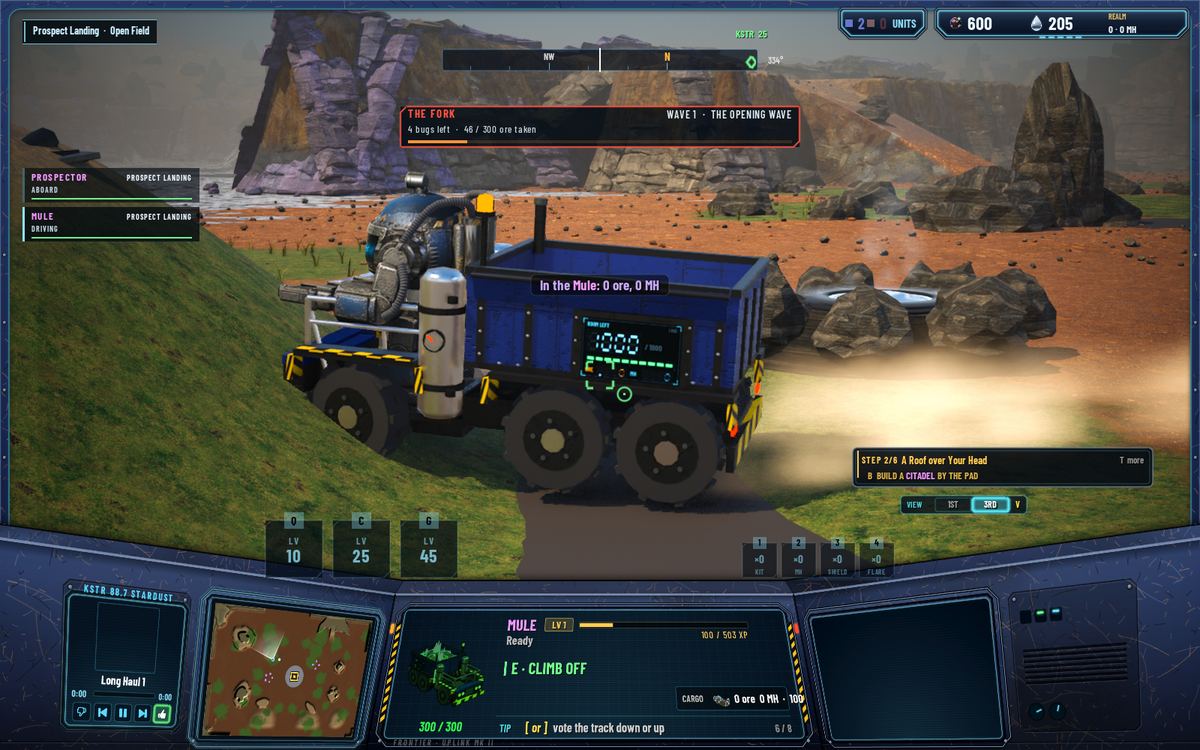
Wheels and tracks
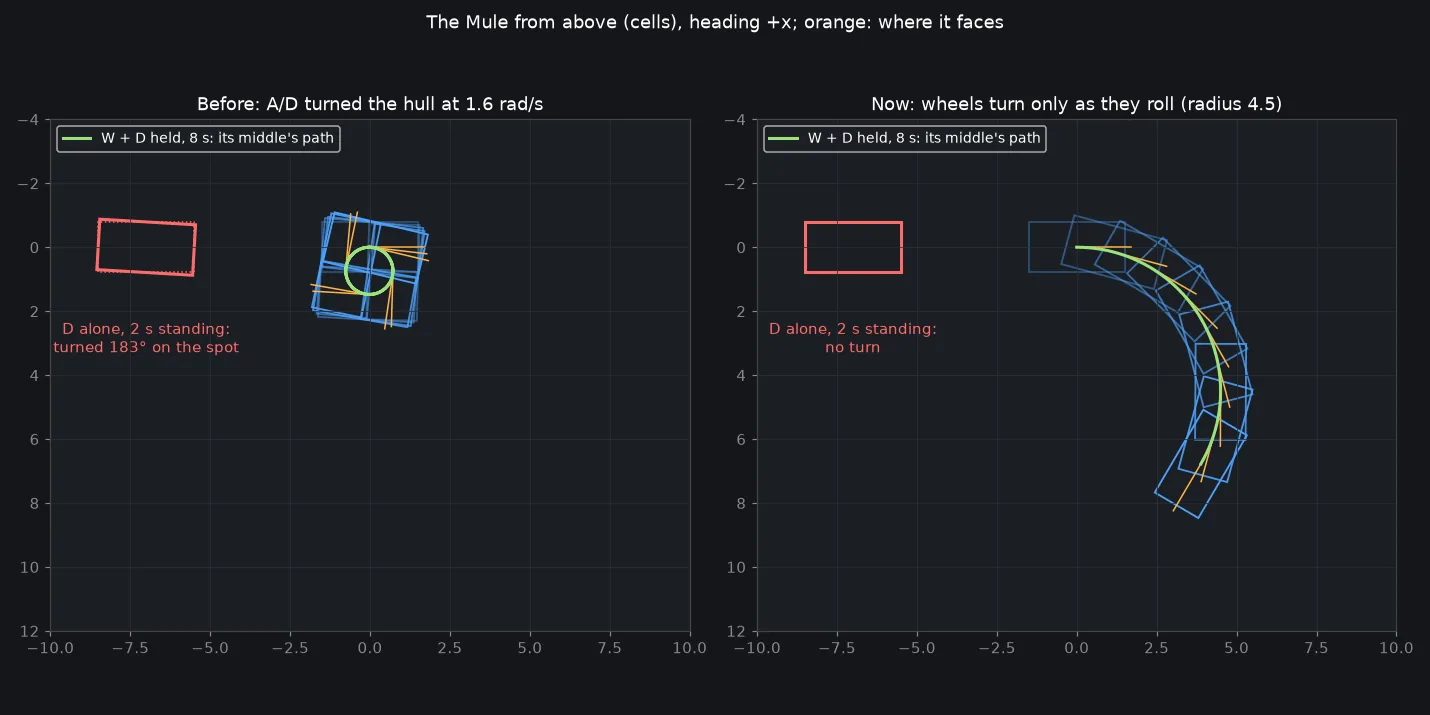
Every kind says what it runs on, read from its model. Wheels (the Mule, the Firefly, the Hailstorm) turn only while rolling, on an arc no tighter than the kind's radius: 4.5 cells for the Mule, 2.7 for the Firefly, 3.2 for the Hailstorm. Backing up turns the other way. Tracks (the Longbow) pivot on the spot. The AI drives by the same rule and makes three-point turns.
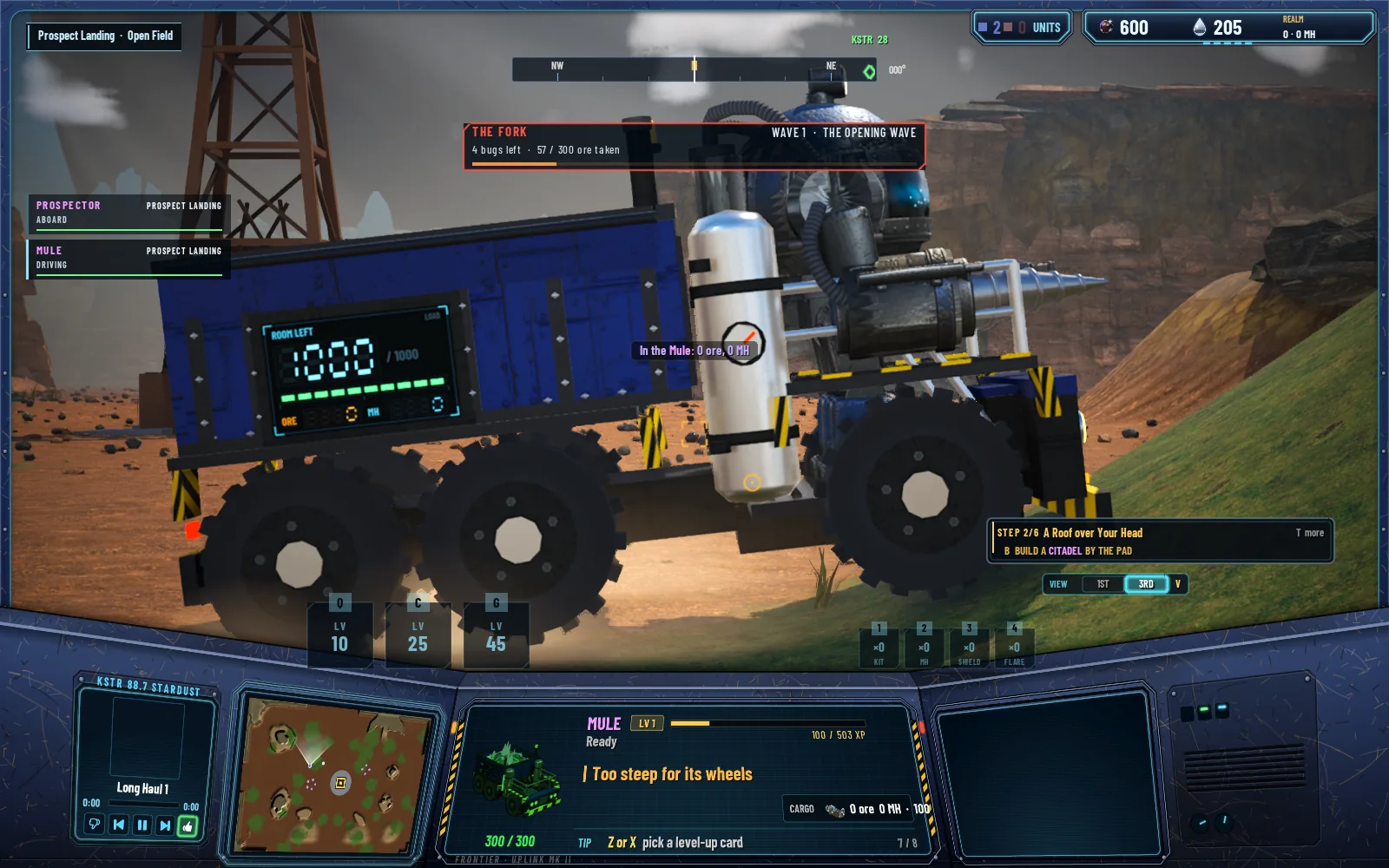
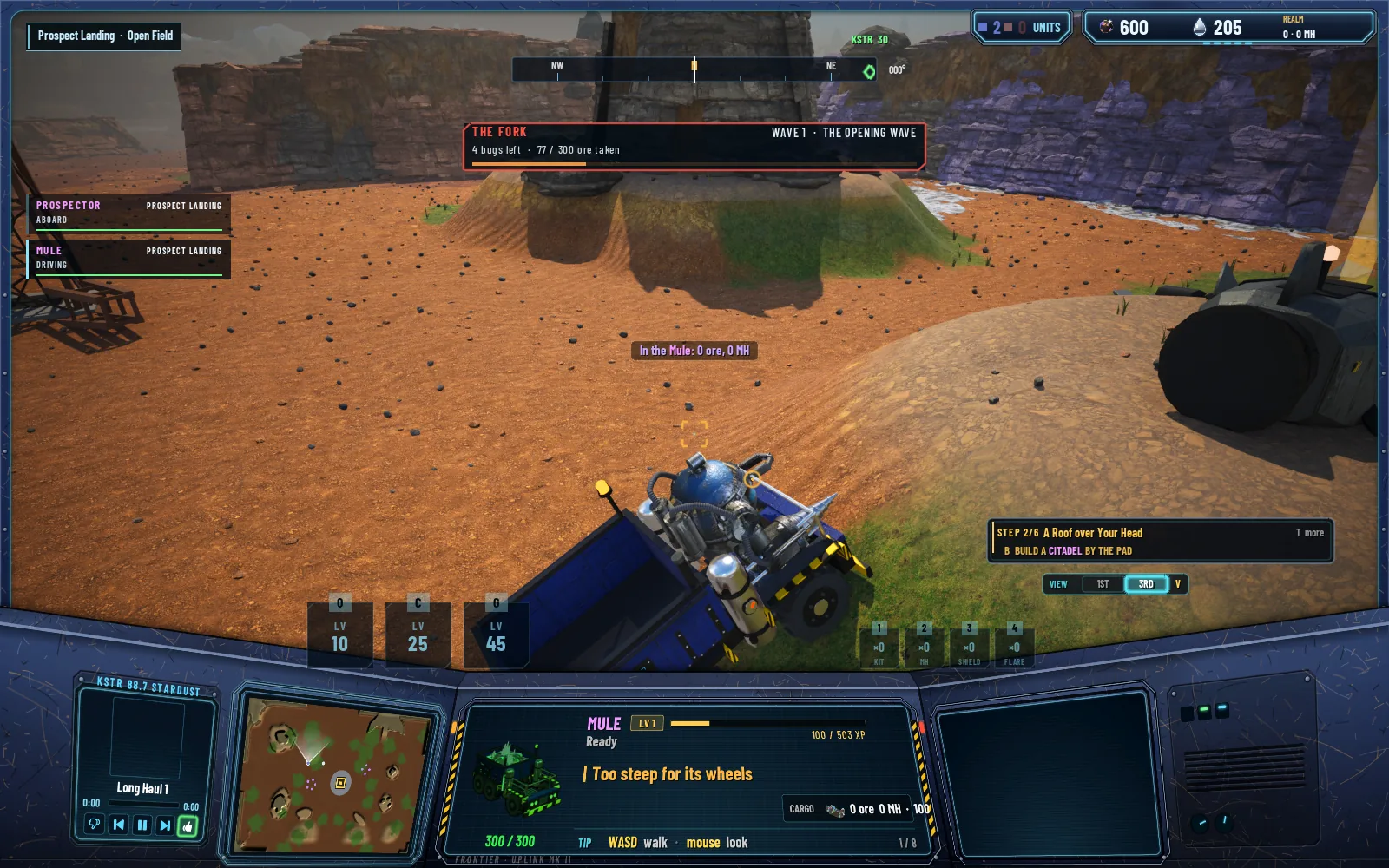
Wheels climb up to 25 degrees and tracks up to 35. A face steeper than that stops the vehicle and the dashboard says "Too steep for its wheels". In each region 0.8 to 4.1% of the open ground is too steep for wheels. A vehicle is drawn pitched and rolled to the ground under its four contacts, so a crest or a ditch shows as its wheels feel it.
Fast empty, slow full
I wanted it 50% faster than the Prospector empty and slower as it fills. Its top speed is 1.5 times the Prospector's walk empty, 5.91 cells a second, falling in a straight line to 0.3 times at 1000, 1.18 cells a second.
The drive
One drive step in the core runs the server, the game's prediction and the AI's driver alike.
- It takes 1.6 seconds to reach top speed empty and 1.4 seconds longer full. Let go of W and it coasts.
- S brakes, then reverses at 0.6 of the top. Space brakes hard, and with the wheel turned it's a handbrake: the grip drops and the back steps out.
- The steering lock shrinks with speed: the 4.5-cell arc at a crawl opens to about 8 at top speed.
- The body turns and the momentum follows late. Up to a sideways pull of 4 cells a second squared the grip eats the slide; past it the Mule drifts. Full lock at top speed is a mild drift, the handbrake a big one, and either dies out within a second of letting go.
- Coasting on anything over about 5 degrees it rolls downhill. Uphill its top speed drops (on a 17-degree slope to 0.55 of it); downhill it runs up to 1.25 times.
- A step is taken in pieces of 0.2 cells, so nothing tunnels at top speed. Off a wall it bounces back at 0.3 of its speed.
The body leans with it: nose up on the throttle, down on the brake, rolled out of a turn. Dust grows with speed and clouds off the tyres in a slide, and a lever clunks on a hard brake.
The front wheels used to wobble between the turn and straight ahead. The game read the steer off the motion it drew, and the prediction's small heading corrections flipped it every frame. The steer is part of the unit's state now. The test that would have caught it holds a turn at 60 and 144 steps a second and checks the steer never flips. Every number is in one table for me to tune by feel.
Driving the Mule
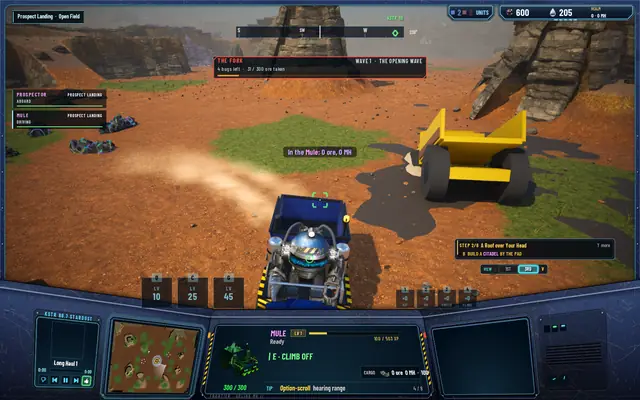 Turning on its arc.
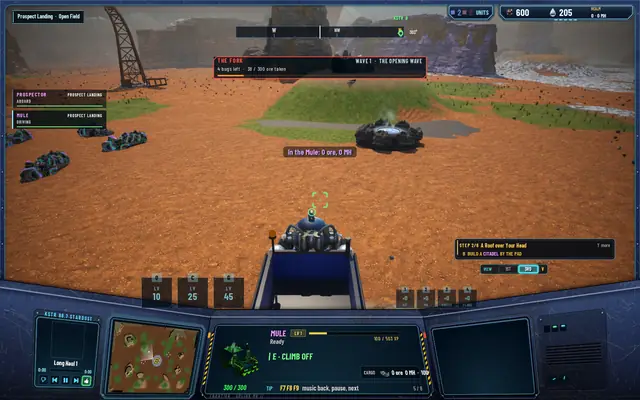 Space from top speed.
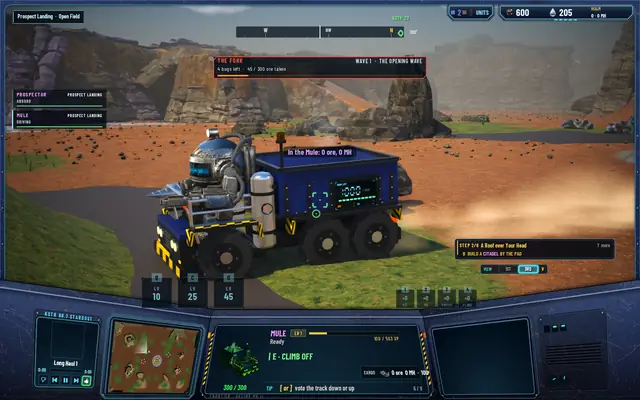 The handbrake drift, 1.
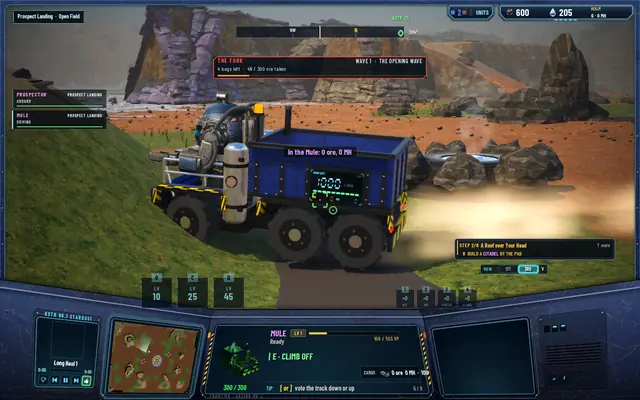 2.
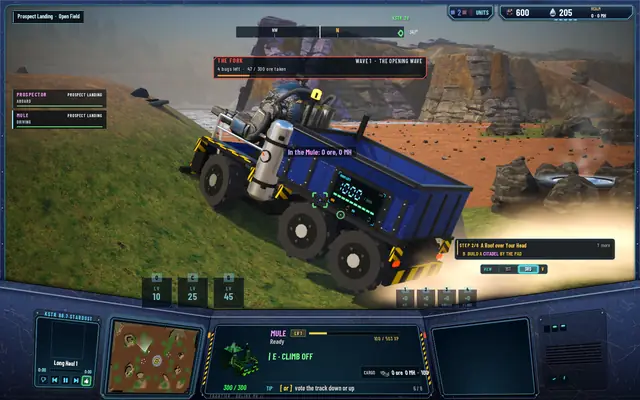 3.
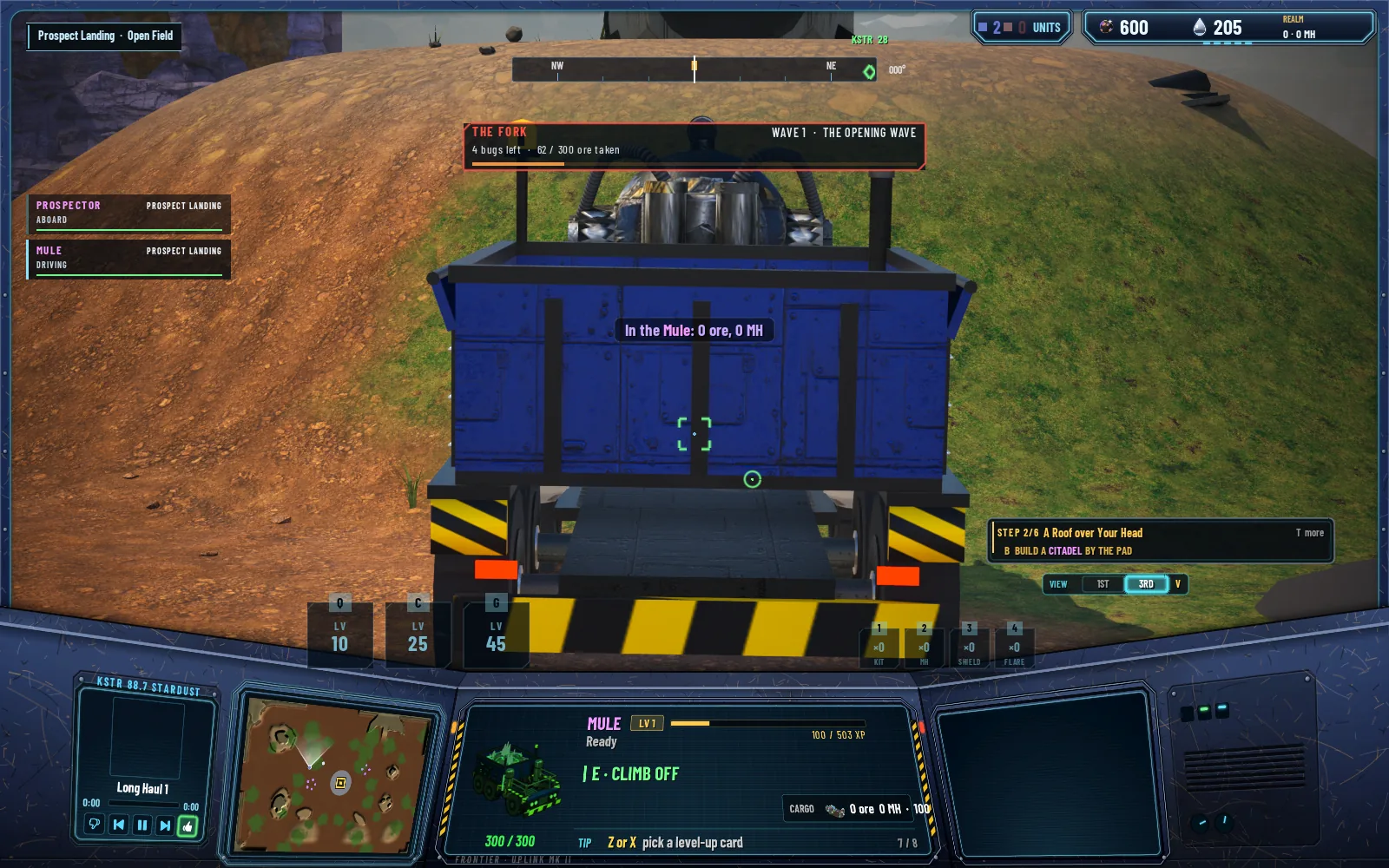
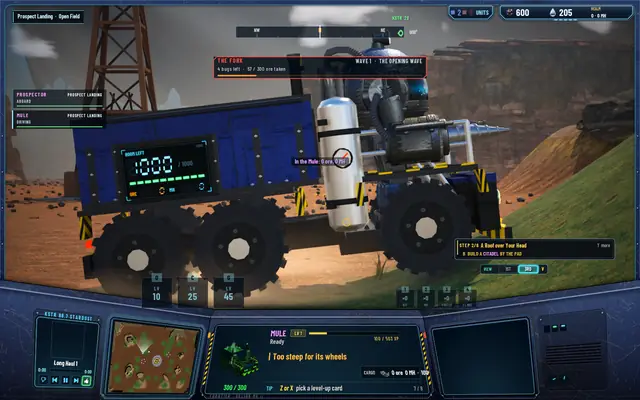 Climbing, tilted to the ground.
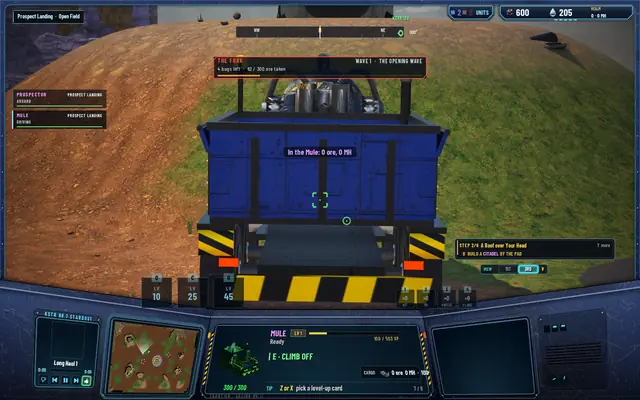 Rolled to the slope.
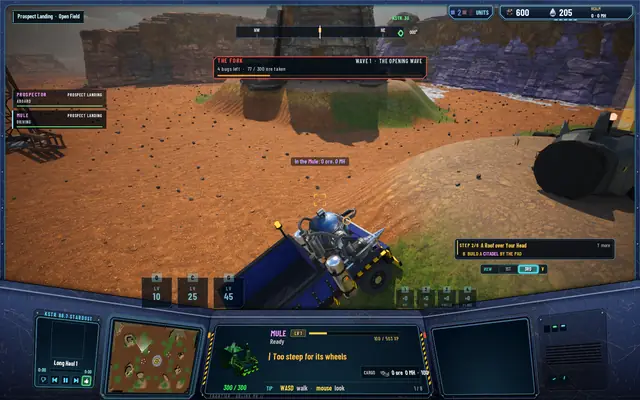 Too steep for its wheels.
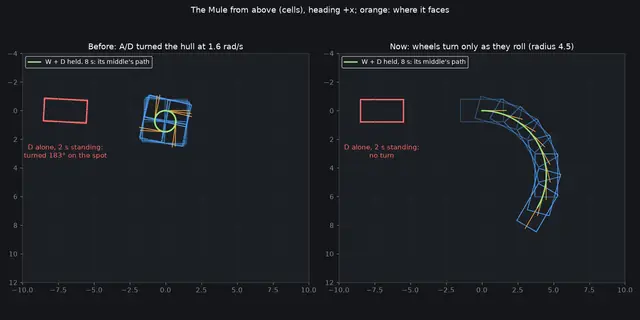 Before and after from above: W and D held for 8 s, D alone standing.
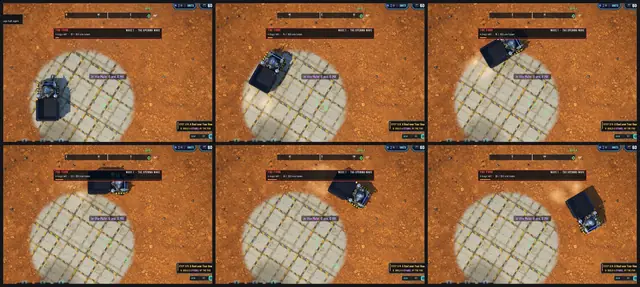 The turning circle, a frame every 2 s.
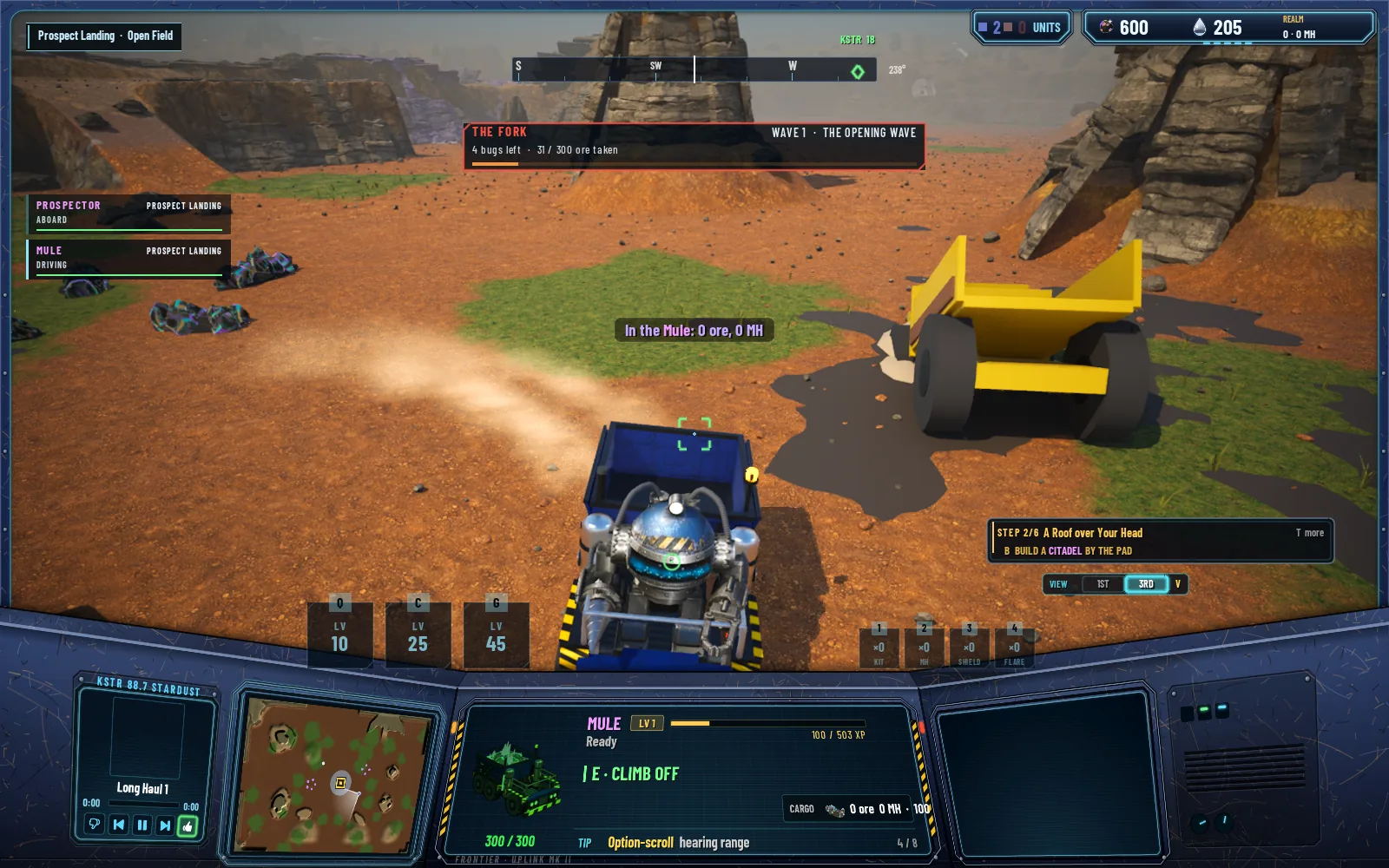
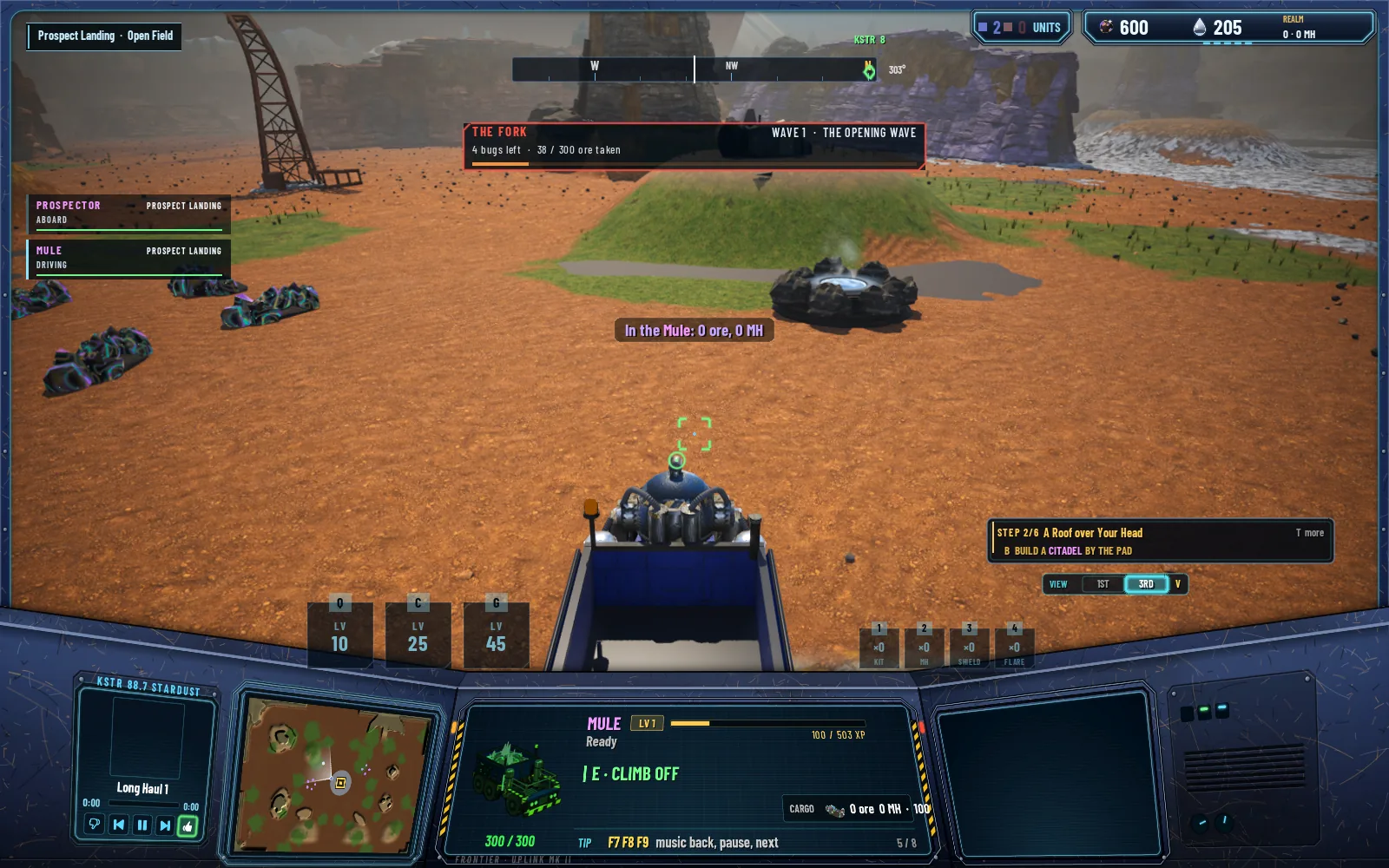
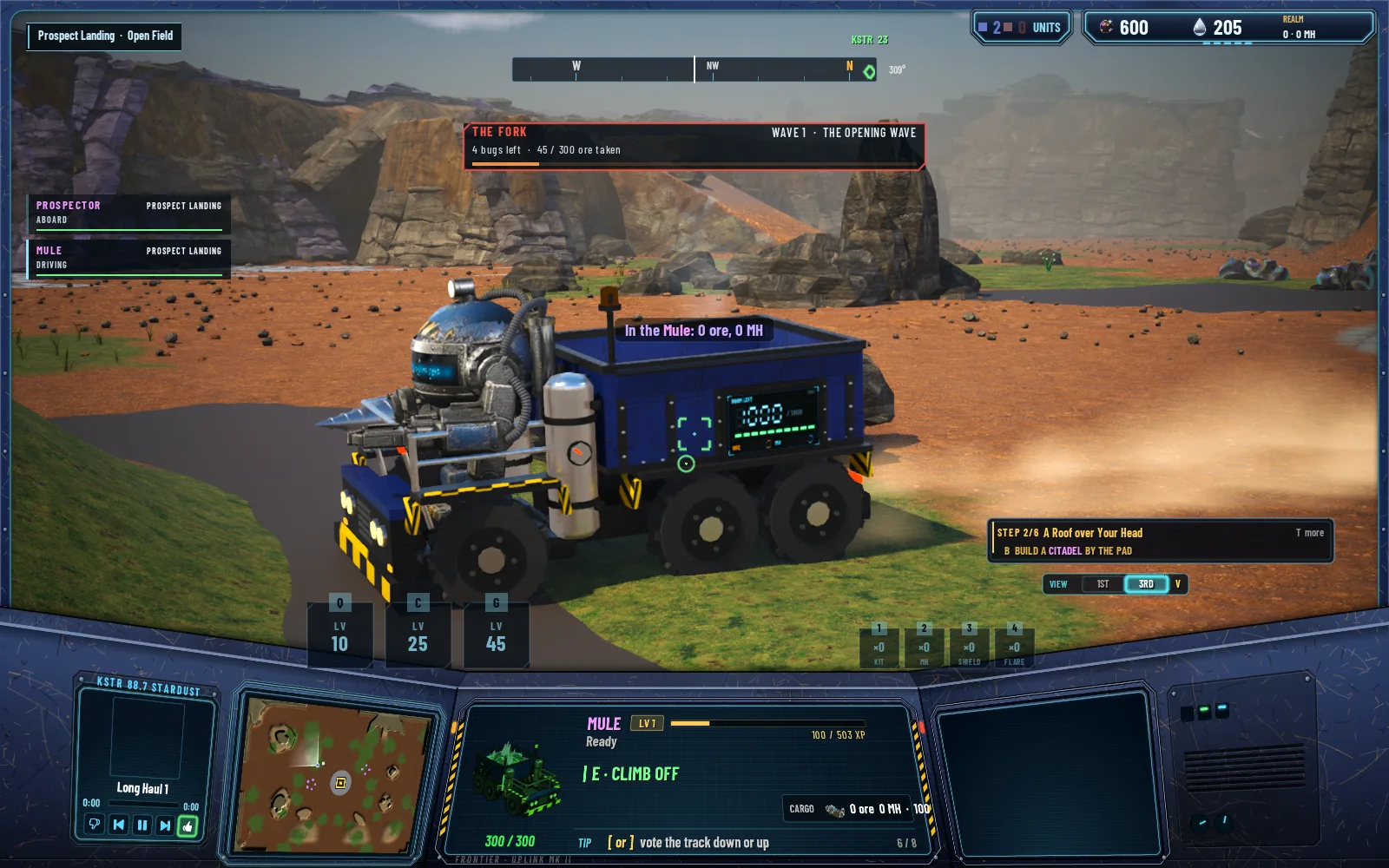
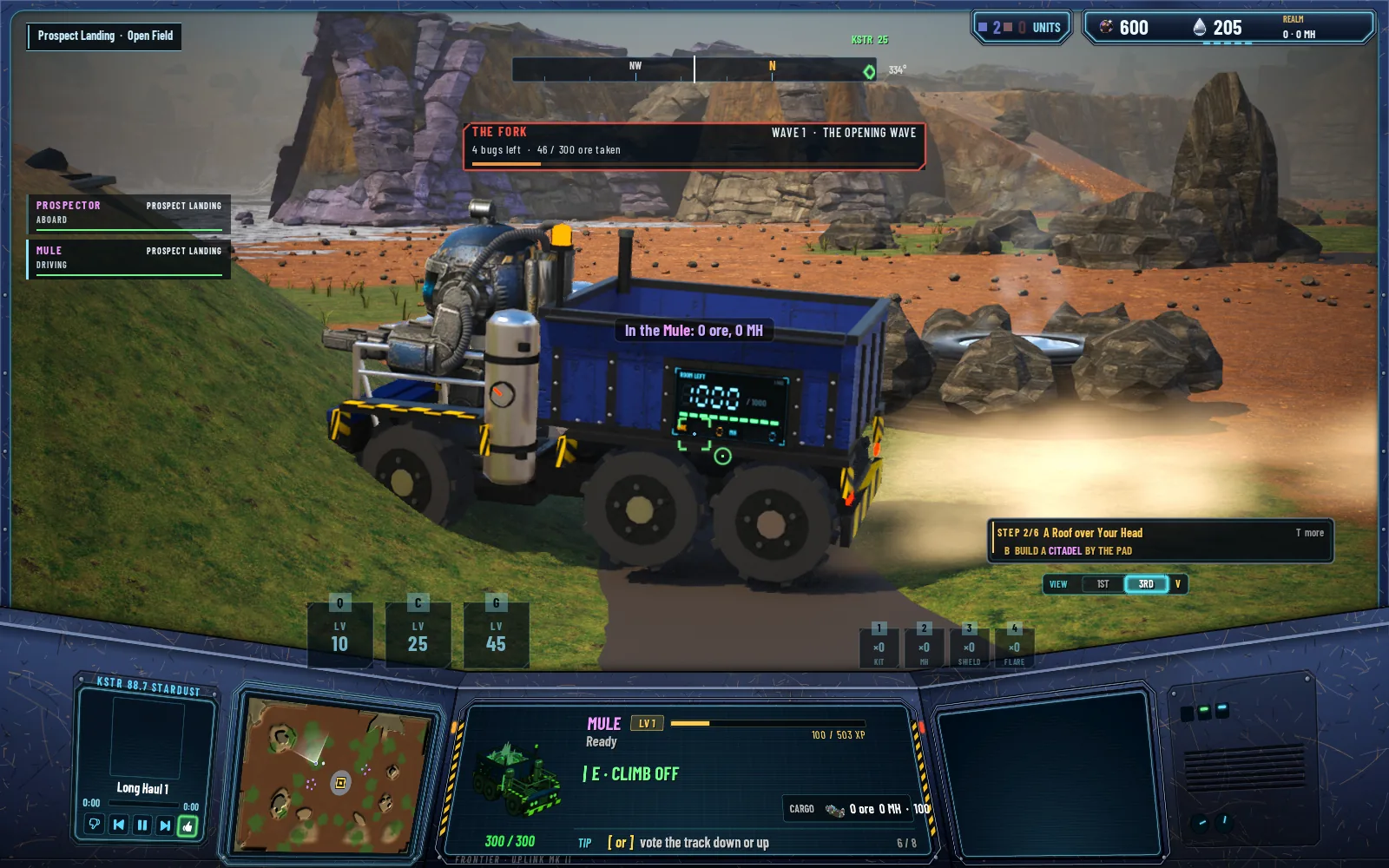
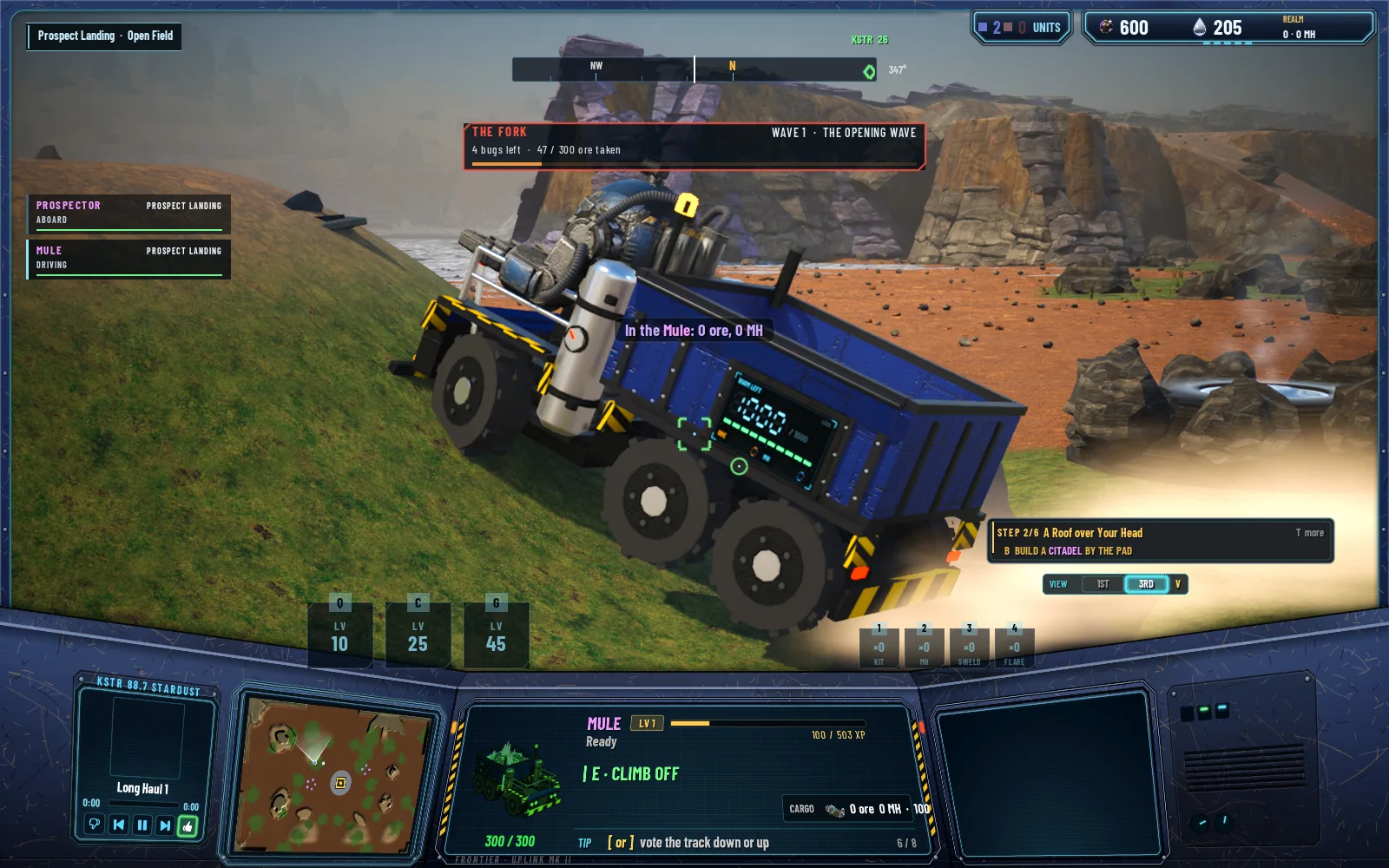
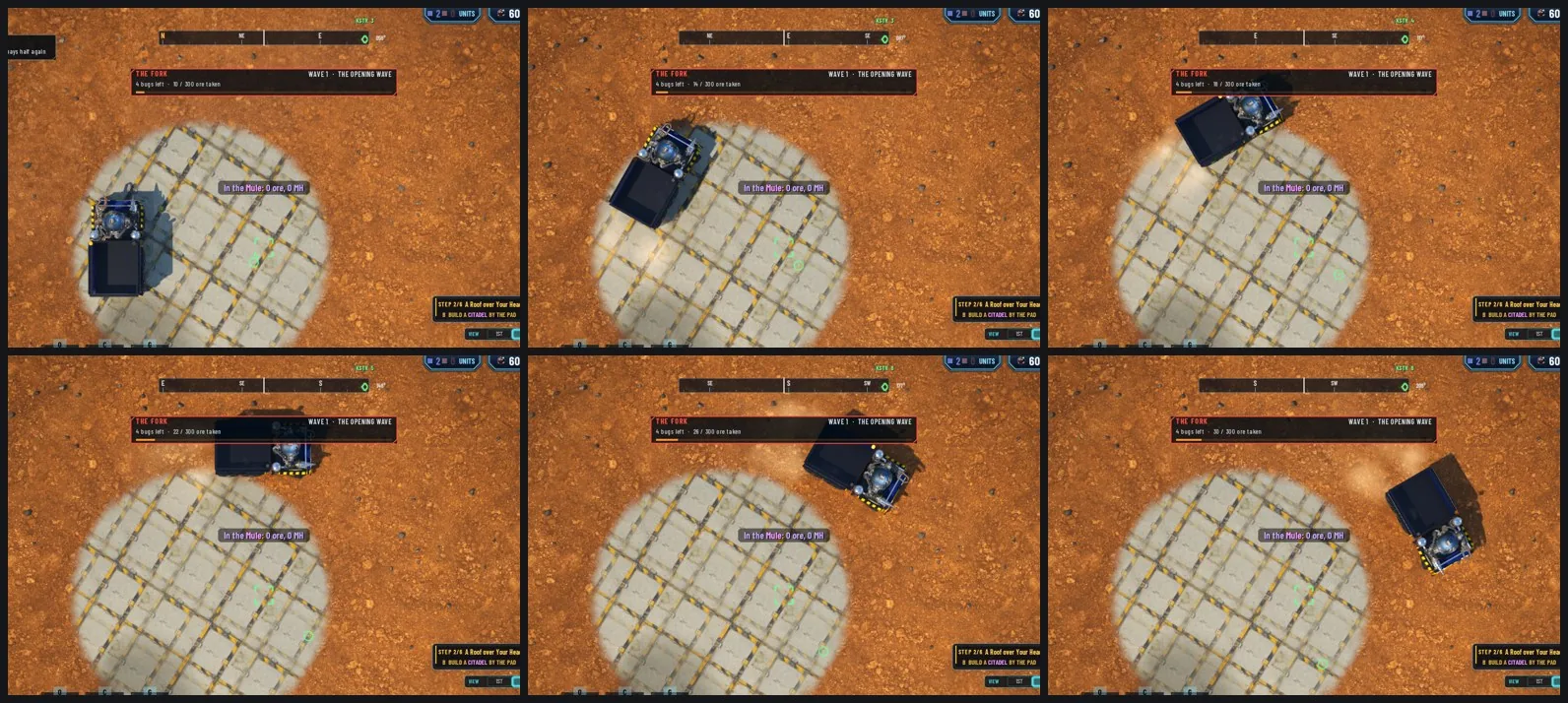
Heavy things shove light ones
On 20 October bodies became solid: before that my Prospector could walk right through the Mule. Then a Prospector walking head on into the Mule pushed the Mule away, because every body acted as a wall to everything else. Since 21 October bodies meet by mass.
| Body | Mass |
|---|---|
| Shardling, Gloamwing | 0.5 |
| Prospector, Ranger, Comet | 1 |
| Mule | 6 empty, 12 full |
| Longbow | 8 |
| Atlas | 20 |
| The Matriarch | 50 |
A mover shoves any body no heavier than itself, the overlap split by their masses, and sweeps a lighter one aside off its line: a Mule clears a Prospector off its bumper. A heavier body holds it, as does one with a wall behind it. Shoving costs speed: an empty Mule pushing through a Prospector loses 6% of its speed a second. A Prospector walking into a parked Mule, empty or full, stops at it or slides along it, and the Mule stays put. An anchored unit can't be moved, and buildings and rocks are walls as before.